Featured
Guide to Managing Solvent Exposure
Guide to Managing Solvent Exposure
Hydrocarbon & Oxygenated Solvents
This document is one of a series of 'Best Practice Guidelines' published by the European Solvents Industry Group (ESIG).
It aims to assist solvent users, particularly Small and Medium Size Enterprises (SMEs), in using both hydrocarbon and oxygenated solvents safely.
This guide is aimed at managing solvent exposure in relation to the inhalation of vapour, and does not cover other health, safety and environmental impact. However, it is standard industry practice to minimise skin and eye contact, and to ensure the safe and envirommentally sound use of solvents.
The approach described is based on a recent UK Health and Safety Executive initiative, although some changes have been introduced to adapt the scheme specifically for solvents.
The approach represents a basic but effective way of defining the measures required to control exposure during solvent use via a simple risk assessment procedure.
Specialist knowledge is not required to use the approach. Users should confirm that conclusions meet specific national regulatory requirements.
The overall risk assessment and control process is shown in Figure:
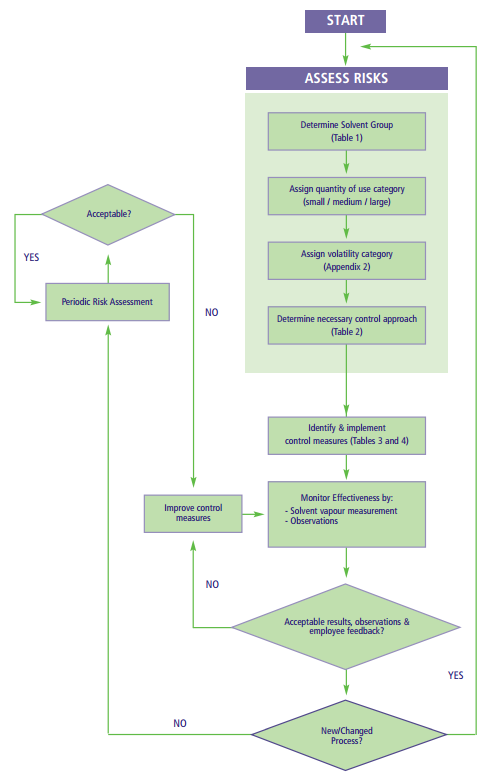
The shaded area indicates the risk assessment procedure.
The role of measuring solvent vapour concentrations, which was the subject of a previous ESIG Best Practice Guideline 2 is also shown.
Introduction
Health effects of solvents
Hazard, exposure & risk The basis of the approach
The risk assessment & control procedure
Grouping of solvents
Solvent groups for hydrocarbon & oxygenated solvents based on inhalation hazard
Definition of control aproach
Selection of specific control measures
Examples of equipment/ventilation design for common activities involving solvents
Case studies
Key messages
Appendix 1: Risk phrases that can relate to solvents
Appendix 2: Determination of how readily a solvent forms a vapour
Appendix 3: Glossary
www.esig.org
Allegati
|
Descrizione |
Lingua |
Dimensioni |
Downloads |
 |
|
EN |
135 kB |
2 |