IARC Monographs Volume 127 / June 2021
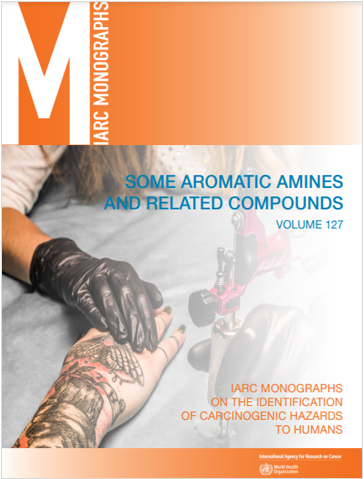
IARC Monographs on the Identification of Carcinogenic Hazards to Humans Volume 127: Some Aromatic Amines and Related Compounds
This volume of the IARC Monographs provides evaluations of the carcinogenicity of six chemicals: ortho-anisidine and ortho-anisidine hydrochloride, ortho-nitroanisole, aniline and aniline hydrochloride, and cupferron.
ortho-Anisidine, and its salt, ortho-anisidine hydrochloride, are mainly used as chemical intermediates in the synthesis of azo pigments and dyes for consumer products, textiles, paper, and cardboard.
ortho-Nitroanisole is used primarily as a precursor for the manufacture of ortho-anisidine.
Aniline, the parent compound of aniline hydrochloride, is a High Production Volume chemical used in the synthesis of isocyanates, dyes and pigments, and rubber-processing chemicals, and in the production of pharmaceuticals, herbicides, fungicides, and of many consumer goods, including textiles, leather, and colourants, including tattoo ink. Tobacco smoke is a main source of exposure to aniline in the general population.
Cupferron is a reagent used to separate metals such as copper, iron, tin, vanadium, and thorium from other metals.
For all agents, data were sparse regarding exposure levels, but indicated that exposures are higher in occupational situations than in the general population.
An IARC Monographs Working Group reviewed evidence from cancer studies in humans, cancer bioassays in experimental animals, and mechanistic studies to assess the carcinogenic hazard to humans of exposure to these agents and concluded that:
- ortho-anisidine and ortho-anisidine hydrochloride, ortho-nitroanisole, and aniline and aniline hydrochloride are probably carcinogenic to humans (Group 2A)
- cupferron is possibly carcinogenic to humans (Group 2B).
Collegati
Allegati
|
Descrizione |
Lingua |
Dimensioni |
Downloads |
 |
|
EN |
6047 kB |
9 |