UNI ISO/TS 23624:2026
ID 25952 | 09.04.2026 / In allegato Preview
UNI ISO/TS 23624:2026
Apparecchi di sollevamento - Uso sicuro delle funi in fibra ad alta prestazione nelle applicazioni con apparecchi di sollevamento
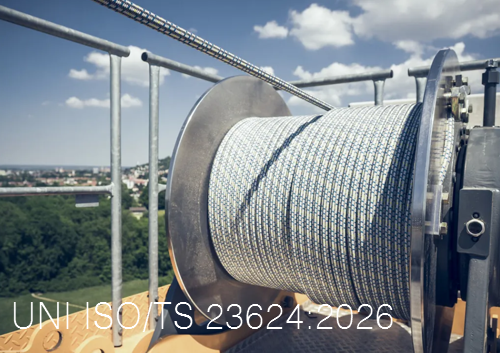
La specifica tecnica fornisce indicazioni per l'uso sicuro di funi in fibra ad alta prestazione (HPFR) nelle applicazioni con apparecchi di sollevamento. Il documento riguarda anche le applicazioni con argani.
La specifica tecnica tratta i criteri di prestazione e la valutazione necessaria per consentire la scelta delle HPFR, nonché linee guida sulle migliori pratiche relative alle procedure, alle prove e alla manutenzione per l'uso sicuro delle HPFR nelle applicazioni con apparecchi di sollevamento, comprese le disposizioni per il montaggio/smontaggio. I criteri di prestazione sono relativi alle attività svolte quando si utilizzano le gru come previsto, compresi il montaggio/smontaggio, il funzionamento e i controlli e la manutenzione richiesti.
La presente specifica tecnica non tratta le cosiddette funi ibride, che sono una combinazione di fili d'acciaio e fibre ad alte prestazioni, in cui la capacità di carico è ripartita tra i fili d'acciaio e la fibra ad alte prestazioni. Il presente documento non tratta le HPFR utilizzate per applicazioni ad alto rischio (ad esempio il trasporto di metallo fuso caldo).
Data entrata in vigore: 09 aprile 2026
Adotta: ISO/TS 23624:2021
_________
ISO/TS 23624:2021(en)
Cranes - Safe use of high-performance fibre ropes in crane applications
Introduction
Recent developments of high-performance fibre ropes (HPFR) made from synthetic fibre have led to comparable strength with regard to steel wire ropes. The main advantages of using HPFR on cranes are:
a) light weight (significant weight reduction);
b) no environment pollution by grease (no re-lubrication);
c) easy handling (faster and easier assembly/disassembly);
d) robust spooling (increased tolerance for spooling failures).
The use of HPFR on cranes has already started, however, there is limited experience with HPFR in comparison to the long-term application of steel wire ropes.
For steel wire ropes, substantial experience over many decades covering both rope selection and discard criteria exists, which can be found in International Standards (e.g. ISO 16625 and ISO 4309). Currently, there is no standard available that deals with design and discard criteria for the use of HPFR on cranes. Therefore, this document has been developed based on the content of the FEM 5.024 guideline.
The FEM 5.024 guideline was developed by the Fédération Européenne de la Manutention (FEM) as a joint project with various stakeholders in the industry. It is based on first experiences with mobile cranes and the requirements/limits in some cases can be specific to mobile cranes only.
This document includes additional input from tower crane and electric overhead traveling crane manufacturers. Adaptation to other crane types or applications can be necessary.
This document reflects the current knowledge about the use of HPFR on cranes.
1 Scope
This document gives guidance for the safe use of high-performance fibre ropes (HPFR) in crane applications.
This document also covers winch applications. The mention of crane applications implicitly includes winch applications.
This document covers performance criteria and the necessary evaluation to enable selection of HPFR as well as best practice guidelines on procedures, testing and maintenance to safely operate HPFR in crane applications including provisions for assembly/disassembly.
The performance criteria are related to tasks performed when using cranes as intended, including assembly/disassembly, operation and required checks and maintenance.
This document does not deal with so-called hybrid ropes which are a combination of steel wire and high-performance fibres, where the load bearing capability is shared between steel wires and the high-performance fibre.
This document does not deal with HPFR used for high risk applications (e.g. transport of hot molten metal).
2 Normative references
The following documents are referred to in the text in such a way that some or all their content constitutes requirements of this document. For dated references, only the edition cited applies. For undated references, the latest edition of the referenced document (including any amendments) applies.
ISO 2307:2019, Fibre ropes - Determination of certain physical and mechanical properties
ISO 4309:2017, Cranes - Wire ropes - Care and maintenance, inspection and discard
ISO 9554:2019, Fibre ropes - General specifications
3 Terms and definitions
For the purposes of this document, the following terms and definitions apply.
ISO and IEC maintain terminology databases for use in standardization at the following addresses:
- ISO Online browsing platform: available at https://www.iso.org/obp
- IEC Electropedia: available at https://www.electropedia.org/
3.1
assembly/disassembly
operations needed to set up/down a crane in a specific configuration or change the configuration
3.2
competent person
designated person, suitably qualified by knowledge and experience, and with the necessary instruction to ensure that the required operations are carried out correctly
3.3
cyclic bending over sheave
CBOS
condition where a section of rope experiences a repeated straight-bent-straight change of curvature onto and off a sheave or roller
Note 1 to entry: In a CBOS test, the fibre rope runs around at least one test sheave. A rope pulling force is applied via an appropriate system. During the test, the rope is running in a constant manner on and off the sheave, taking the condition straight–bent–straight. A movement straight–bent–straight over a test sheave counts as one bending cycle for the rope.
3.4
efficiency factor
loss of rope force of a high-performance fibre rope (3.5) when bent over sheaves, resulting in rope pull differences
3.5
high-performance fibre rope
HPFR
rope based on high-performance fibres, with a high tensile strength, high modulus and low elongation at break
Note 1 to entry: These fibre ropes have mechanical characteristics in the range of steel wire with regard to strength per area, axial stiffness and elongation at break [e.g. aromatic polyamide (aramid), high modulus polyethylene (HMPE), liquid crystal polymer (LCP), see 4.3.1].
3.6
maximum rope pull
MRP
maximum force applied to the rope during design [of the rope drive (3.13)], taking into account dynamic effects, efficiency of the rope drive, reeving, spread, etc., during operation
3.7
minimum breaking strength
MBS
minimum force achieved by a new rope when tested in accordance with a recognized procedure/test method
3.8
point of discard
point where the tested failure or wear criterion is achieved considering the residual lifetime (3.10)
3.9
residual breaking strength
RBS
force a used fibre rope achieves at a point in time when tested according to a recognized procedure/test method
3.10
residual lifetime
remaining lifetime at a point in time, where the attested failure criterion is not yet fully achieved
3.11
actual rope diameter
dact
diameter of the circle circumscribed about the cross-section of the rope, usually measured under a given tension and method
[SOURCE:ISO 1968:2004, 5.1.10]
3.12
nominal rope diameter
d
reference value for the diameter of a given high-performance fibre rope (3.5)
[SOURCE:ISO 1968:2004, 5.1.11]
3.13
rope drive
reeving system according to ISO 4306-1, including the drum (actuator) or other actuators, e.g. cylinders or traction systems
3.14
rope safety factor
n
ratio between breaking strength of the rope and the maximum rope pull (3.6)
3.15
termination
means of connecting the high-performance fibre rope (3.5) to load bearing parts (e.g. crane, winch, hook)
3.16
torsional stiffness
ability of the high-performance fibre rope (3.5) to resist externally induced twist
[...]
Fonte: UNI / ISO
Allegati
|
Descrizione |
Lingua |
Dimensioni |
Downloads |
 |
|
EN |
2836 kB |
4 |