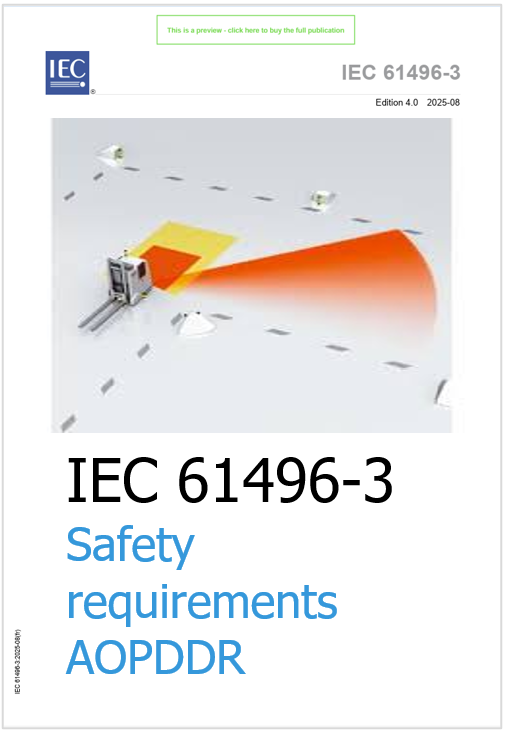
CEI EN IEC 61496-3:2025 / Safety requirements AOPDDR
ID 24435 | Update 01.12.2025 / Preview attached
IEC 61496-3:2025
Safety of machinery - Electro-sensitive protective equipment - Part 3: Particular requirements for active opto-electronic protective devices responsive to diffuse reflection (AOPDDR)
Edition 4.0 08.2025
Pubblicazione CEI Novembre 2025
CEI EN IEC 61496-3
Classificazione CEI: 44-23
Sicurezza del macchinario - Equipaggiamento elettrosensibile di protezione - Parte 3: Prescrizioni particolari per dispositivi di protezione fotoelettrici attivi che rispondono alla riflessione diffusa (AOPDDR)
La Parte 3 della Norma CEI EN IEC 61496 specifica requisiti aggiuntivi per la progettazione, la costruzione e il collaudo di dispositivi di protezione elettrosensibili (ESPE) facenti parte di un sistema di sicurezza e progettati specificamente per rilevare persone o parti di persone, utilizzando dispositivi optoelettronici di protezione attivi sensibili (per la funzione di rilevamento) alla riflessione diffusa (AOPDDR). Un ESPE può includere funzioni opzionali relative alla sicurezza, i cui requisiti sono riportati nell'Allegato A della presente Norma e nell'Allegato A della Norma CEI EN 61496-1.
La presente Norma:
- si limita agli ESPE che non richiedono l'intervento umano per il rilevamento e agli ESPE che rilevano oggetti che entrano o sono presenti in una o più zone di rilevamento;
- non affronta gli aspetti necessari per la classificazione complessa o la differenziazione dell'oggetto rilevato e neppure i requisiti e i test per applicazioni all’esterno;
- non tratta gli AOPDDR che impiegano radiazioni con il picco di lunghezza d'onda al di fuori dell'intervallo compreso tra 820 nm e 1 100 nm, e quelli che impiegano radiazioni diverse da quelle generate dallo stesso AOPDDR;
- è pertinente per gli AOPDDR con una dimensione minima rilevabile degli oggetti compresa tra 30 mm e 200 mm;
- può essere pertinente per applicazioni diverse dalla protezione delle persone, ad esempio per la protezione di macchinari o prodotti da danni meccanici: in tali applicazioni possono essere appropriati requisiti diversi;
- non contempla i requisiti di emissione di compatibilità elettromagnetica (EMC).
Rispetto alla precedente edizione le modifiche tecniche più significative sono:
a) alcune clausole relative ai requisiti e alle procedure di prova sono state adattate o eliminate perché consolidate nella Norma CEI EN IEC 61496-1 ed. 2020 (ad esempio 5.4.6.2 Sorgenti luminose e articolo A.9);
b) modifica della probabilità minima di rilevamento e dei requisiti di rilevamento dei guasti per l'AOPDDR di tipo 2;
c) l'utilizzo dell'AOPDDR come dispositivo di sgancio è descritto come funzione opzionale nell’Articolo A.13.
La presente Norma Tecnica recepisce il testo originale inglese della Pubblicazione IEC.
Questa pubblicazione è il recepimento in lingua inglese della Norma europea EN IEC 61496-3:2025 come Norma nazionale italiana.
_________
IEC 61496-3:2025 specifies additional requirements for the design, construction and testing of non‑contact electro-sensitive protective equipment (ESPE) designed specifically to detect persons or parts of persons as part of a safety-related system, employing active opto-electronic protective devices responsive to diffuse reflection (AOPDDRs) for the sensing function. Special attention is directed to requirements which ensure that an appropriate safety-related performance is achieved. An ESPE can include optional safety-related functions, the requirements for which are given both in Annex A of this document and in Annex A of IEC 61496‑1:2020.
NOTE
"Non-contact" means that physical contact is not required for sensing.
This document does not specify the dimensions or configurations of the detection zone and its disposition in relation to hazardous parts for any particular application, nor what constitutes a hazardous state of any machine. It is restricted to the functioning of the ESPE and how it interfaces with the machine.
AOPDDRs are devices that have either
- one or more detection zone(s) specified in two dimensions (AOPDDR-2D), or
- one or more detection zone(s) specified in three dimensions (AOPDDR-3D)
wherein radiation in the near infrared range is emitted by an emitting element(s).
When the emitted radiation impinges on an object (for example, a person or part of a person), a portion of the emitted radiation is reflected to a receiving element(s) by diffuse reflection. This reflection is used to determine the position of the object.
Opto-electronic devices that perform only a single one-dimensional spot-like distance measurement, for example, optical proximity switches, are not covered by this document.
This document is limited to ESPE that do not require human intervention for detection. It is limited to ESPE that detect objects entering into or being present in a detection zone(s).
This document does not address those aspects required for complex classification or differentiation of the object detected.
This document does not address requirements and tests for outdoor application.
Excluded from this document are AOPDDRs employing radiation with the peak of wavelength outside the range 820 nm to 1 100 nm, and those employing radiation other than that generated by the AOPDDR itself. For sensing devices that employ radiation of wavelengths outside this range, this document can be used as a guide. This document is relevant for AOPDDRs having a minimum detectable object size in the range from 30 mm to 200 mm.
This document can be relevant to applications other than those for the protection of persons, for example, for the protection of machinery or products from mechanical damage. In those applications, different requirements can be appropriate, for example when the materials that are recognized by the sensing function have different properties from those of persons and their clothing.
This document does not deal with electromagnetic compatibility (EMC) emission requirements.
This fourth edition cancels and replaces the third edition published in 2018. This edition constitutes a technical revision.
This edition includes the following significant technical changes with respect to the previous edition:
a) some requirement clauses and test procedures have been adapted or removed because they have been consolidated in IEC 61496-1:2020 (e.g. 5.4.6.2 Light sources and Clause A.9);
b) change of the minimum probability of detection and fault detection requirements for Type 2 AOPDDR;
c) using the AOPDDR as a trip device is described as an optional function in Clause A.13.
...
add preview
Collegati
Allegati
|
Descrizione |
Lingua |
Dimensioni |
Downloads |
 |
|
IT |
271 kB |
24 |