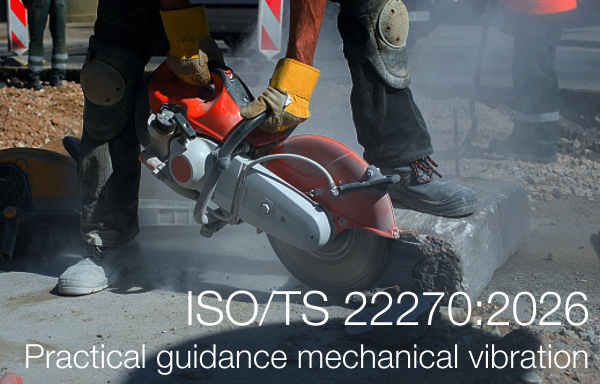
ISO/TS 22270:2026 / Practical guidance of hand-transmitted mechanical vibration on the hand, wrist or forearm
ID 26661 | 10.07.2026 / Preview attached
ISO/TS 22270:2026
Mechanical vibration - Practical guidance and requirements for the monitoring and measurement of hand-transmitted vibration on the hand, wrist or forearm
Pubblication: 6 July 2026
Edition: 1
This document provides guidance and requirements on the evaluation of daily exposures to hand-arm vibration in the workplace where measurement or monitoring systems are fitted to the hand, wrist, or arm. This document provides guidance and to equipment manufacturers on how to provide suitable information to users on the scope and limitations of their equipment. It also provides guidance to users on the practical use and validation of these systems for monitoring or measurement in the workplace.
This document provides information on measurement methods that complement the methods required for ISO 5349-1.
NOTE
The methods described in this document are not meant to replace measurements carried out in accordance with ISO 5349-1 when, for example, fulfilling duties under national regulations for either workplace vibration exposures or machinery vibration emissions.
_________
The objective of this document is to provide practical guidance and requirements for the monitoring and measurement of hand-transmitted vibration on the hand, wrist, or forearm.
Wearables, MEMS (micro-electro-mechanical systems) transducers, and other technologies are widely available and routinely used for monitoring hand-arm vibration (HAV) exposure in the workplace.
These systems and devices are robust, can be inexpensive and substantially smaller than traditional measurement systems on which standards such as ISO 5349-1 and ISO 5349-2 are based.
These evolving technologies provide opportunities for practical in situ monitoring and measurements conducted over long periods of time, which can include the use of multiple machines and work processes. These new types of measurements can be at locations on the hand, wrist or forearm; away from the vibrating surface interface where vibration enters the hand.
Formally, measurements away from the hand-machine interface do not comply with ISO 5349-1.
For this reason, measurements away from the hand-machine interface should not replace ISO 5349-1 measurement when, for example, fulfilling duties under national regulations for either workplace vibration exposures or machinery vibration emissions.
Full conformity with ISO 5349-1 is not always required, for example if the purpose is to reduce vibration exposures or for research applications. However, devices using measurement on the body are available and are being used to monitor vibration exposures and augment traditional measurements.
If users account for the limitations of the devices, including the additional measurement uncertainties, they can provide data which supplements that given by the ISO 5349-1 methodology, leading to a better understanding of the risks for those exposed to hand arm vibration. The objective of this document is to highlight the potential benefits and limitations of measurement on the hand, wrist or arm and to provide guidance on how to reduce the impact of the limitations on vibration evaluations.
Body-mounted measurement can allow a simpler, lower-cost monitoring of an individual’s vibration exposure over long periods, such as a full working day, shift, or even a year or more. This type of long-term monitoring can provide valuable information on vibration exposure patterns and indicators to vibration risks. These data can then inform risk control management procedures and thereby reduce the vibration exposure of individuals.
One objective of body-mounted measurement systems is to reduce or remove the need for specialist technicians to be present during measurement, by allowing simple fitting and removal by operators with basic training and automatic data download. By comparison, traditional measurement, that conforms to ISO 5349-1, should be performed by specialists who should have a detailed understanding of the measurement system and awareness of the possible sources of error.
This document provides guidance to those developing on-body measurement systems and for those using these systems. It discusses the factors that need to be considered, such as: instrumentation characteristics, measurement locations on the hand, wrist, or forearm, and the vibration transfer characteristics from the vibrating surface to the body-mounted sensor.
This document is aimed at manufacturers of systems that measure or monitor vibration on the hand, wrist or arm. This document is also aimed at those performing measurements or monitoring of vibration on the hand, wrist, or arm, including those involved in research.
...
add Preview
Collegati
Allegati
|
Descrizione |
Lingua |
Dimensioni |
Downloads |
 |
|
EN |
196 kB |
25 |