Featured
IARC Monographs Volume 137
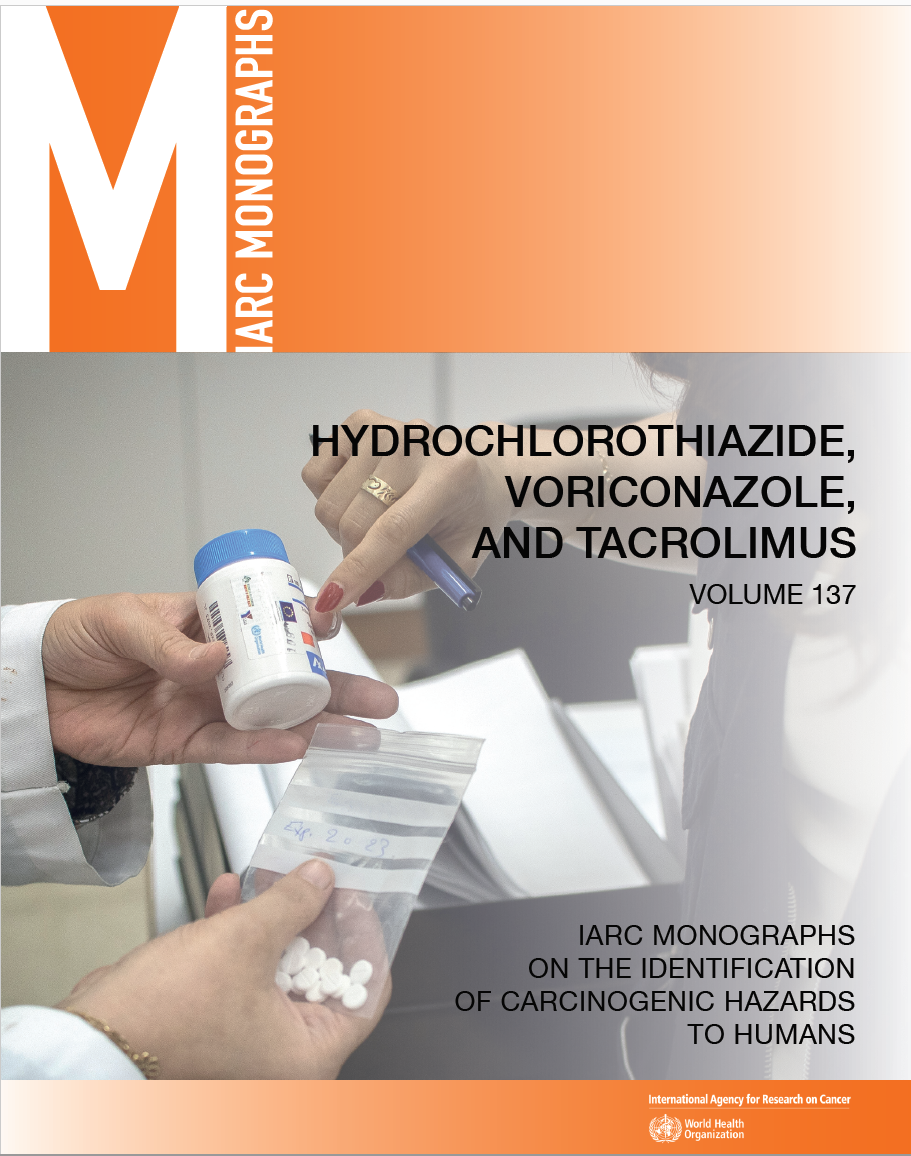
IARC Monographs Volume 137 / Hydrochlorothiazide, voriconazole and tacrolimus
ID 25568 | 17.02.2026 / Attached
This volume of the IARC Monographs provides evaluations of the carcinogenicity of hydrochlorothiazide, voriconazole and tacrolimus.
Hydrochlorothiazide is a prescription-only thiazide diuretic primarily used to treat essential hypertension. It is present in single-ingredient pills as well as in single-pill combinations, which include other antihypertensives (mostly, angiotensin receptor blockers). Although hydrochlorothiazide has increasingly been replaced by newer medications, it remains a commonly prescribed drug because of the high prevalence of hypertension worldwide. The use of single-pill combinations is greater in most high-income countries than in many low- and middle-income countries.
Voriconazole is a broad-spectrum triazole antifungal medication that is used to treat invasive aspergillosis and other serious fungal infections, which are especially common in transplant recipients. Voriconazole is approved in most countries worldwide for use in adults and children aged 2 years and older. Voriconazole is also used for prophylaxis of invasive fungal infections in high-risk transplant recipients. Use is higher in high-income than in middle-income countries.
Tacrolimus is an immunosuppressive medication that is mainly used to reduce the risk of organ rejection in adult and paediatric transplant recipients, and for the prevention of graft-versus-host disease after allogeneic haematopoietic stem cell transplantation. Because systemic tacrolimus is mainly used for solid-organ transplant recipients, the worldwide prevalence of exposure in the general population tracks with the prevalence of transplantation in each country. Topical tacrolimus is indicated as second-line therapy for atopic dermatitis and vitiligo, as an alternative to first-line treatment with topical corticosteroids.
For these three agents, exposure might also occur via the environment or occupation, although it is expected to be magnitudes lower than that from medications.
An IARC Monographs Working Group reviewed evidence from epidemiological studies, cancer bioassays in experimental animals, and mechanistic studies to assess the carcinogenic hazard to humans of exposure to these agents and concluded that hydrochlorothiazide, tacrolimus, and voriconazole are all carcinogenic to humans (Group 1).
[...]
Fonte: IARC
Collegati
Allegati
|
Descrizione |
Lingua |
Dimensioni |
Downloads |
 |
|
EN |
0 kB |
220 |