Featured
Occupational Biomonitoring Guidance Document
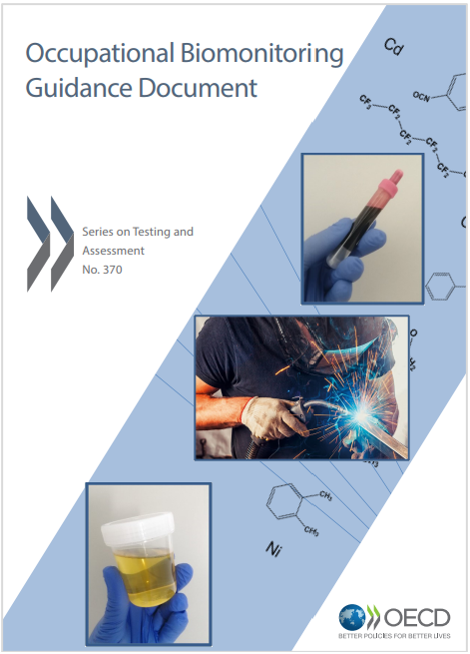
Occupational Biomonitoring Guidance Document / OECD 2022
ID 25914 | 02.04.2026
This occupational biomonitoring guidance document was elaborated in a joint activity including more than 40 institutes / organisations in collaboration with the OECD* Working Party on Exposure Assessment and the OECD* Working Party on Hazard Assessment.
The goal was dual. First, the guidance document presents current approaches used to derive biomonitoring values; and second, it provides globally harmonized recommendations on how-to derive and apply occupational biomonitoring assessment values. The derived health-based human biomarker assessment values are referred to as Occupational Biomonitoring Levels (OBL*s). OBLs* are suitable for the use in exposure assessment and screening a level of health-risk and finally, workplace risk management. Moreover, we strengthen the option of deriving Provisional Occupational Biomonitoring Levels (POBLs*) for chemical substances with limited human toxicity data availability, which can be used for identifying and managing possible occupational health-risks.
The guidance document draws mainly upon exposure and partially on effect-biomonitoring approaches and gained experiences from the regulatory context. The procedures and specifications described in the guidance document aim to facilitate a high quality and sound occupational biomonitoring programmes.
Furthermore, this guidance provides practical guidance on obtaining, evaluating and communicating BM* results following ethical and regulatory requirements. Using harmonised approaches in conducting and evaluating BM* campaigns will also facilitate the usability and interpretation of BM* data in an international context. Harmonised guidance will also help in interpreting levels found in exposed workers across countries. Consequently, this guidance document is relevant for Occupational Health Professionals (OHP*) and occupational safety and health (OSH*) specialists, regulatory authorities, chemical industries, researchers as well as stakeholders interested in addressing occupational and general population biomonitoring. The occupational biomonitoring guidance should increase the derivation and acceptance of OBLs* and implementation of these in biomonitoring programmes to reduce workers' exposures and ultimately, prevent occupational diseases.
...
OECD 2022
Collegati
Allegati
|
Descrizione |
Lingua |
Dimensioni |
Downloads |
 |
Abbonati Sicurezza Lavoro
|
EN |
2738 kB |
31 |