Air Quality Guidelines for Europe - WHO 2000
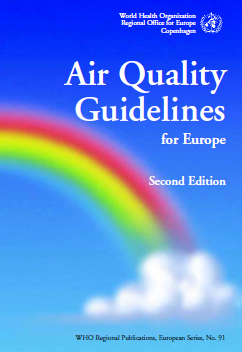
Air Quality Guidelines for Europe - WHO 2000
ID 4268 | Update 10.04.2025
Update 2005 (attached)
WHO convened the Working Group on Air Quality Guidelines in Bonn, Germany, on 18–20 October 2005 to finalize the updated guidelines.
The tasks of the meeting were to formulate guidelines for four specific pollutants (PM, ozone, nitrogen dioxide and sulfur dioxide) and to agree on a supporting text.
The Working Group consisted of the authors of the draft chapters, the external reviewers of the draft s and members of the steering group (see Annex 2). Dr Robert Maynard chaired the meeting, and Dr Aaron Cohen acted as meeting Rapporteur.
Comments on the draft s of the background material, received from the reviewers, were circulated to the steering group members, authors and all reviewers in advance of the meeting. Since not all reviewers participated in the meeting, a list of those who submitted written comments but who were not present at the meeting is also presented in Annex 2.
see attached
________
The primary aim of these guidelines is to provide a basis for protecting public health from adverse effects of air pollution and for eliminating, or reducing to a minimum, those contaminants of air that are known or likely to be hazardous to human health and wellbeing. In the present context, guidelines are not restricted to a numerical value below which exposure for a given period of time does not constitute a significant health risk; they also include any kind of recommendation or guidance in the relevant field.
The guidelines are intended to provide background information and guidance to governments in making risk management decisions, particularly in setting standards, but their use is not restricted to this. They also provide information for all who deal with air pollution. The guidelines may be used in planning processes and various kinds of management decisions at community or regional level.
When guideline values are indicated, this does not necessarily mean that they should be used as the starting point for producing general countrywide standards, monitored by a comprehensive network of control stations. In the case of some pollutants, guideline values may be of use mainly for carrying out local control measures around point sources. To aid in this process, information on major sources of pollutants has been provided.
....
World Health Organization
Regional Office for Europe
Copenhagen
WHO Regional Publications, European Series, No. 91
Allegati
|
Descrizione |
Lingua |
Dimensioni |
Downloads |
 |
|
EN |
3155 kB |
385 |
|
|
|
EN |
1026 kB |
2023 |