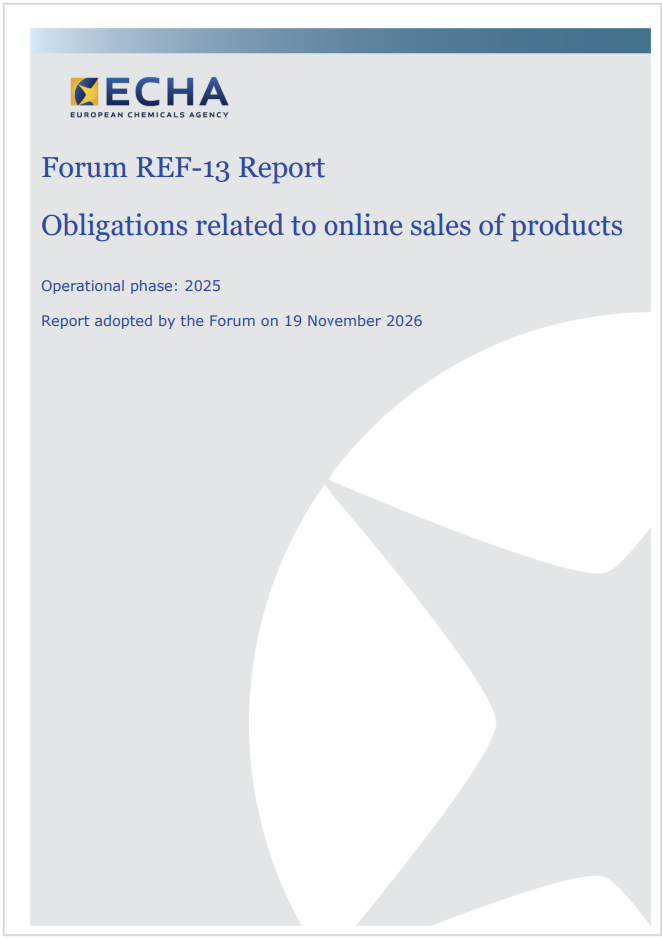
Obligations related to online sales of products - Forum REF 13 Report ECHA
ID 27622 | 26 Novembre 2026 / Attached
The European Chemicals Agency’s Enforcement Forum for Exchange of Information on Enforcement (Forum) has completed its thirteenth REACH-EN-FORCE (REF-13) project.
The project assessed compliance with the requirement to provide hazard information in online offers under Article 48 of the CLP Regulation and with restrictions on hazardous substances, mixtures and articles sold online under REACH, the POPs Regulation. In addition, although not under the Forum’s remit, the RoHS Directive restrictions could have been voluntarily checked by the inspectors as part of integrated enforcement. This enforcement project was carried out in 27 EEA countries, with inspections taking place during 2025.
The project targeted companies supplying hazardous substances, mixtures, or articles online, including traders and online platforms (private sellers excluded). Inspectors selected the regulations and obligations to be investigated from the scope of this project (see Annex II),
taking into account national enforcement priorities and the allocation of responsibilities among the authorities.
Results
The national enforcement authorities (NEAs) in the 27 participant countries inspected a total of 5281 products of which 3424 (65 %) were mixtures, 1627 (31%) were articles and 230 (4%) were substances.
In many Member States, a risk-based approach was used to select the products or offers inspected, and those considered to present the highest risk were prioritised, which may have contributed to a higher-than-expected rate of non-compliance for most obligations examined in the project.
The overall non-compliance rate of the project was 61% of the inspected products with at least one identified non-compliance (77% for substances, 76% for mixtures, and 28% for articles).
For the CLP Regulation, the non-compliance rate for the obligation to provide hazard information in online advertisements (Article 48 of CLP) was 62% for both substances and mixtures. Optional checks for other CLP duties on labelling and packaging were also included in
this project.
For REACH restrictions, 56% of the products checked were non-compliant. The highest noncompliance rate was 92% found for the restrictions on the use of carcinogenic, mutagenic or toxic to reproduction (CMR) substances in consumer products, mainly due to presence of lead in solder wires (100%) and borates in the cleaning products (96%). The rate of non-compliance that were detected for restrictions on hazardous substances in tattoo inks was 92%, for lamp oils 78%, for Perfluoroalkyl carboxylic acids (PFCAs) 29% and for phthalates 19%. Cadmium, nickel, and lead were frequently detected in jewellery with the non-compliance rates of 16%, 13% and 8%, respectively.
Under the POP Regulation, 14 % of the checked products were non-compliant. Short-chain chlorinated paraffins (SCCPs) and Perfluorooctanoic acid (PFOA) were the main substances investigated. SCCPs showed a 12% non-compliance rate, mainly in electrical and electronic equipment and soft plastic consumer products. Non-compliance for PFOA was highest in interior articles, such as bathmats and plastic tablecloths (38%), and textiles (16%) due to water and stain repellent surface treatments.
For RoHS restrictions, which were an optional check in this project, 52% of the controlled products were non-compliant. The highest rate of non-compliance (48%) was found for the restriction on lead in electrical and electronic equipment. Notable levels of non-compliance were
also detected for phthalates (DEHP 26%, DBP 15%) and cadmium (14%) whereas for other controlled restrictions non-compliance remained below 10%. Non-compliant products commonly included lamps, fans, headphones, radios, and other electronic equipment.
For the above legislations and duties there were also smaller samples of product types and substances checked for which no non-compliance was found.
Conclusions
The overall non-compliance rate in the project was 61% of products with at least one noncompliance), indicating that e-commerce remains a significant channel for non-compliant products entering the EEA market.
Online platforms (74%) showed a higher rate of non-compliance than webshops (46%).
Identical or similar products were often available from multiple traders on the same or different platforms. This created challenges for effective enforcement, particularly where information enabling the traceability of products and traders was limited. Removing a non-compliant product does not necessarily prevent the same or similar product from remaining available through other offers or being re-listed.
Main recommendations
Online traders should strengthen compliance and supplier due diligence, especially for high-risk products. Online platforms should strengthen preventive measures to limit the availability of dangerous or non-compliant products, including systematic monitoring of Safety Gate notifications, to prevent identified non-compliant products from remaining available through other traders or platforms or being re-listed.
The European Commission and the Member States should continue their joint efforts to strengthen the enforcement of legislation regarding online trade, notably through common guidelines, suitable IT tools, and improved data sharing.
Consumers could be cautious of products with limited information on the seller or product, particularly low-cost jewellery, toys, plastic items, and chemicals. They could look for basic safety information and warnings and check the EU Safety Gate website for information about unsafe products.
ECHA European Chemicals Agency, - December 2026
Allegati
|
Descrizione |
Lingua |
Dimensioni |
Downloads |
 |
|
EN |
969 kB |
4 |