
~ 2000 / 2026 ~
// Documenti disponibili n:
48.991
// Documenti scaricati n:
41.486.106
// Newsletter n:
4075
Documenti Chemicals
Featured
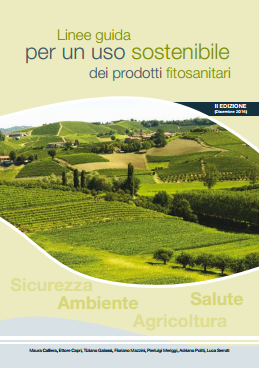
Linee guida per un uso sostenibile dei prodotti fitosanitari - II edizione (Dicembre 2016)
Il manuale, aggiornato a dicembre 2016, raccoglie un insieme di raccomandazioni in grado di garantire una gestione sicura dei prodotti fitosanitari nel loro complesso.
È strutturato in capitoli specifici e illustra le diverse fasi che vanno dal momento dell’acquisto fino a quello dello smaltimento dei contenitori. Nelle diverse fasi vengono evidenziati gli aspetti più rilevanti nell'ottica di minimizzare i potenziali rischi di contaminazione di tipo puntiforme e, contestualmente,
Featured
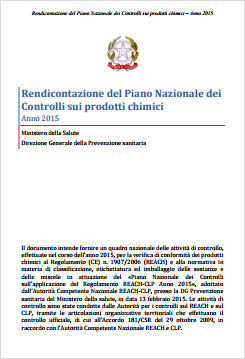
Rendicontazione del Piano Nazionale dei Controlli sui prodotti chimici
Anno 2015
Il documento intende fornire un quadro nazionale delle attività di controllo, effettuate nel corso dell’anno 2015, per la verifica di conformità dei prodotti chimici al Regolamento (CE) n. 1907/2006 (REACH) e alla normativa in materia di classificazione, etichettatura ed imballaggio delle sostanze e delle miscele in attuazione del «Piano Nazionale dei Controlli sull’applicazione del Regolamento REACH-CLP Anno 2015», adottato dall’Autorità Competente Nazionale REACH-CLP, presso la DG Prevenzione sanitaria del [...]
Featured
Linea Guida Assogastecnici Etichette/SDS Miscele
Linea Guida Assogastecnici per la redazione di Etichette e Schede di Dati di Sicurezza per le principali categorie di Miscele
Etichette e Schede di Dati di Sicurezza (SDS) sono uno dei tanti esempi di interazione tra i Regolamenti REACH e CLP, in quanto sono regolamentate dal primo e influenzate dai criteri di classificazione previsti dal secondo (che, ricordiamo, si rifanno al GHS, il sistema globale armonizzato della classificazione ed etichettatura delle sostanze chimiche promosso dall’ONU)
Regolamento CLP prodotti fitosanitari
Documento orientativo per la classificazione dei prodotti fitosanitari in applicazione al Regolamento (CE) 1272/2008
Il presente documento offre una serie di orientamenti di base in merito alle modalità operative ed ai criteri stabiliti dal nuovo Regolamento (CE) 1272/2008 relativo alla classificazione, all’etichettatura e all’imballaggio (Classification, Labelling and Packaging, CLP) delle sostanze e delle miscele entrato in vigore il 20 gennaio 2009 negli Stati membri dell’Unione Europea.
In particolare, il presente lavoro rappresenta un documento di orientamento per la [...]
Featured
Templates for a Chemical Safety Report (CSR)
Formato: doc
The CSR template (section 9 and 10) suggests how the information as required in Annex I of REACH can be reported.
1. Chemical Safety Report - (Section 9 and 10) for non PBT/vPvB substances
2. Chemical Safety Report - (Section 9 and 10) for substances (considered as) PBT/vPvB
Sections 1 to 8 of the CSR Part B can be generated by the CSR IUCLID plug-in:
https://iuclid.eu/
ECHA 2017
Regolamento (CE) n. 1907/2006 REACH
REACH Allegato I
Disposizioni generali [...]
Exposure scenarios semiconductor industry examples
The European Chemicals Agency (ECHA)/semiconductor industry collaboration was established to gain practical experience in generating exposure scenarios (ESs) that would be integral elements of the chemical safety report (CSR).
The examples are related to industrial use of three substances in production of semiconductor devices (“microchips”).
Project participants strove to achieve a high level of understanding of semiconductor (SC) processes through information sharing and a site visit to observe actual semiconductor manufacturing operations. Although not all [...]
Featured
Guida etichettatura e imballaggio Regolamento CLP - 09.2016 ITA
Guida CLP - IT 2a Edizione 09.2016
Guida all'etichettatura e all'imballaggio a norma del regolamento (CE) n. 1272/2008 - CLP
Il presente documento descrive le disposizioni specifiche per l’etichettatura e l’imballaggio di sostanze e miscele chimiche di cui ai titoli III e IV del regolamento (CE) n. 1272/2008
(regolamento CLP o "CLP").
Lo scopo del presente documento è assistere i fabbricanti, gli importatori, gli utilizzatori a valle e i distributori di sostanze e miscele nell’efficace [...]
Featured
Guide on Safety data sheets and Exposure scenarios
The Guide helps suppliers and recipients of safety data sheets to compile and understand substance and use information.
The Guide was originally an interactive online publication that provided information for the recipients of safety data sheets and exposure scenarios in a user-friendly way. It has now been updated to include useful tips for suppliers on issues to watch out for within each section.
At the same time, it has been converted into [...]
Featured
GUIDE CLP Regulation
Classification, and Labelling guide in accordance with EC Regulation 1272/2008
The document gives guidance for the classification and labelling for products that meet all of the following criteria:
a) the products are defined as “gases” according to the CLP Regulation with the addition of two liquids (Hydrogen fluoride and Methylbutene)
b) they are all allowed to be put on the market in the EU i.e. they have either an EC number, they have been pre-registered or registered [...]
Featured
Guida Regolamento sulle materie plastiche
Materiali e gli oggetti di materia plastica destinati a venire a contatto con i prodotti alimentari
Orientamenti dell'Unione sul regolamento (UE) n. 10/2011 (Regolamento materie plastiche) riguardante i materiali e gli oggetti di materia plastica destinati a venire a contatto con i prodotti alimentari, per quanto concerne le informazioni all'interno della catena di approvvigionamento
Il presente documento orientativo fa parte di una serie di documenti redatti allo scopo di fornire orientamenti sull'applicazione del regolamento (UE)
Featured
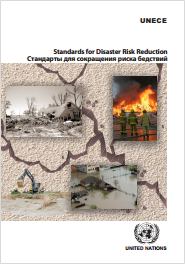
Standards for Disaster Risk Reduction
Disaster risk prevention can be regarded as a facet and as a result of sustainable development.
Standards help businesses and organizations progress towards all three dimensions of sustainable development –environmental, economic and social – and at the same time help them address and, in some cases, completely master risks that without proper management would have disastrous consequences.
In each of these dimensions, at the same time as standards help deliver on development and growth, they [...]
Featured
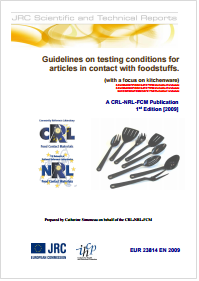
Guidelines on testing conditions for articles in contact with foodstuffs
As part of comparability of the data which ensures free safe trade in the European Union (EU), the Community Reference Laboratory (CRL) and National Reference Laboratories (NRLs) for Food Contact Materials (FCM) under Regulation EC No 882/2004 have a duty to exemplify a unified position on sampling and test conditions when these are not explicitly established or detailed in existing Directives/Regulations, and without prejudice to those.
For plastic food contact [...]
Featured
Fire Hazards of Oxygen and Oxygen enriched Atmospheres
This document explains the fire hazards resulting from handling oxygen and the relevant protective measures that should be taken.
This document consists of three parts. Part I, is intended for line managers and supervisors.
It provides the background to the subject and a description of the fire and explosion hazards associated with oxygen and oxygen enriched atmospheres.
Part II, is Appendix B, and is a summary of Part I suitable to be produced as a [...]
Featured
Guida per le esenzioni a norma dall'Articolo 5(8) della Direttiva RoHS - Draft
Allegato il Modello di Richiesta esenzione
La domanda di concessione, di rinnovo o di revoca di un’esenzione è inoltrata alla Commissione in conformità dell’allegato V (Art. 5).
La direttiva 2011/65/UE (RoHS 2) limita l'uso di alcune sostanze pericolose nelle apparecchiature elettriche ed elettroniche (AAE) immesse nel mercato europeo.
Se un articolo rientra nell'ambito di applicazione delle apparecchiature stabilite dalla direttiva RoHS 2, deve essere controllato assicurando che [...]
Featured
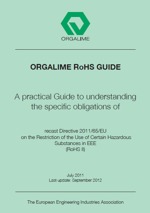
RoHS Guide ORGALIME 2012
A practical Guide to understanding the specific obligations of recast Directive 2011/65/CE on the Restriction of the Use of Certain Hazardous substances in EEE (RoHS II)
Directive 2002/95/EC on the Restriction of Use of Certain Hazardous Substances in Electrical and Electronic Equipment (known as the “RoHS Directive” or “RoHS I”) restricts the use of lead, cadmium, mercury, hexavalent chromium, polybrominated biphenyls and polybrominated diphenylethers in certain electrical and electronic equipment since 1 July 2006.
In December 2008, the European Commission [...]
Featured
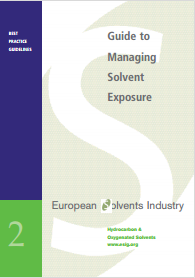
Guide to Managing Solvent Exposure
Hydrocarbon & Oxygenated Solvents
This document is one of a series of 'Best Practice Guidelines' published by the European Solvents Industry Group (ESIG).
It aims to assist solvent users, particularly Small and Medium Size Enterprises (SMEs), in using both hydrocarbon and oxygenated solvents safely.
This guide is aimed at managing solvent exposure in relation to the inhalation of vapour, and does not cover other health, safety and environmental impact. However, it is standard industry practice [...]
Featured
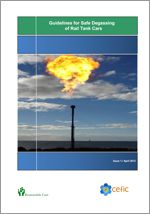
Guidelines for Safe Degassing of Rail Tank Cars
In Europe, degassing of Rail Tank Cars (rtc’s) is mostly done at rtc workshops and not at specialised cleaning stations. Workshops offer this activity as an extra service to their customers.
The degassing operations and associated activities like tank entry and nitrogen purging, are hazardous activities which require the right equipment, skilled personnel, detailed procedures and, above all, a proper safety management system.
The scope of this document includes:
- Degassing (gas freeing) of rtc’s [...]
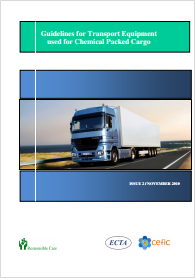
Guidelines for Transport Equipment used for Chemical Packed Cargo
The objective of the present guidelines is to promote the use of the appropriate equipment for the transport of packed chemical cargo.
The scope of these guidelines includes existing and new transport vehicles, trailers and containers used for:
- the different modes of transport except air transport;
- the carriage of palletized and non-palletized packed cargo;
- the transport of dangerous and non-dangerous goods;
- FTL (full truck loads) and LTL (less than [...]
Featured
Il documento raccoglie tutte le risposte alle domande che sono state poste alla Commissione da parte delle autorità nazionali degli Stati membri e ha come finalità quella di facilitare l'applicazione armonizzata della direttiva in tutta l'Unione europea.
Si ricorda a tale fine che le risposte coprono solo aspetti di carattere generale, senza mai affrontare eventuali situazioni specifiche proprie dei singoli Stati membri o degli operatori economici.
Le [...]
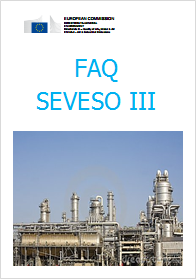
Seveso III FAQ
La Commissione Europea ha pubblicato una serie di FAQ sulla Direttiva 2012/18/CE – Seveso III.
Il documento raccoglie tutte le risposte alle domande che sono state poste alla Commissione da parte delle autorità nazionali degli Stati membri e ha come finalità quella di facilitare l'applicazione armonizzata della direttiva in tutta l'Unione europea.
Si ricorda a tale fine che le risposte coprono solo aspetti di carattere generale, senza mai affrontare eventuali situazioni specifiche proprie dei singoli Stati membri o degli operatori economici.
Le [...]
Featured
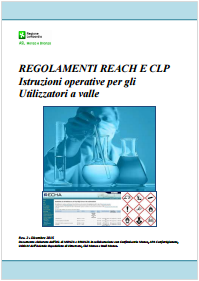
Regolamenti REACH E CLP: Istruzioni operative per gli Utilizzatori a valle
La presente guida è rivolta a tutte le imprese del settore manifatturiero, che utilizzano prodotti chimici nello svolgimento delle proprie attività industriali o artigianali e che sono definiti dal regolamento REACH come “utilizzatori a valle”.
Il presente documento ha lo scopo di riassumere i principali obblighi dell’utilizzatore a valle e di fornire istruzioni operative per il relativo adempimento; è stato realizzato seguendo le linee guida dell’ECHA. E’ bene sottolineare che le [...]
New version of Chesar available in June
The new release date for the update of ECHA's Chemical Safety Assessment and Reporting tool, Chesar, is 21 June 2016.
Helsinki, 19 May 2016 – The webinar on Chesar 3 will be on the same day. Those who are taking part in the webinar will be given access to the application beforehand to get familiar with it. So, if you are still planning to register for the webinar, do it soon.
At the same time,
Featured
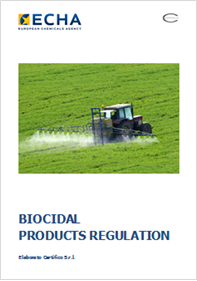
Biocidal Product Regulation
Focus
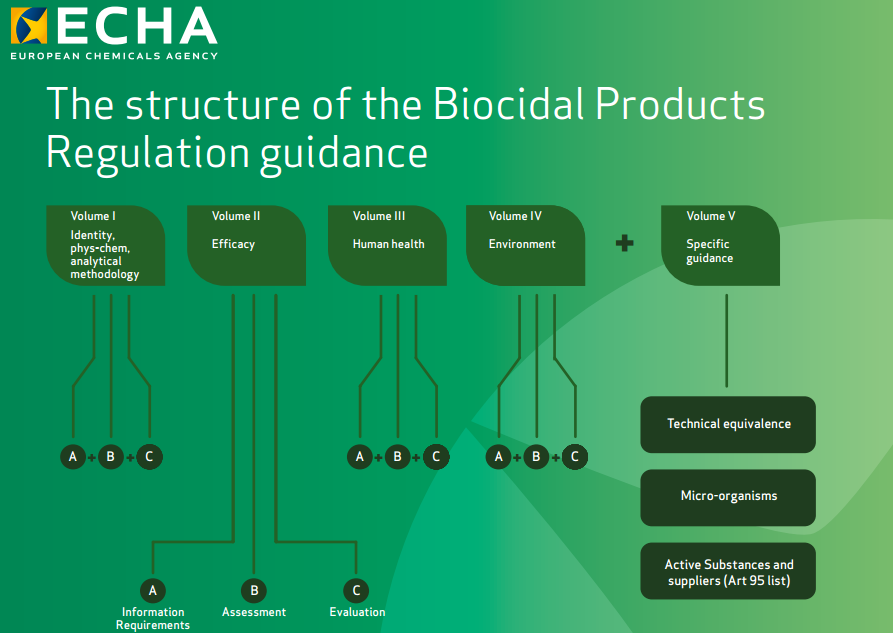
The Biocidal Product Regulation (BPR, Regulation (EU) 528/2012) concerns the placing on the market and use of biocidal products, which are used to protect humans, animals, materials or articles against harmful organisms, like pests or bacteria, by the action of the active substances contained in the biocidal product.
The Biocidal Products Regulation (BPR, Regulation (EU) 528/2012) concerns the placing on the market and use of biocidal products, which are used to protect humans, animals, materials or [...]
Featured
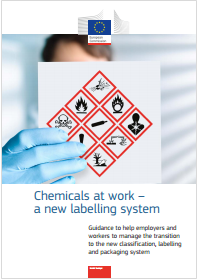
Chemicals at work a new labelling system
Guidance to help employers and workers to manage the transition to the new classification, labelling and packaging system.
This document is intended to provide practical guidance to employers and workers on how the directly acting CLP regulation ((EC) No 1272/2008 on the classification, labelling and packaging of substances and mixtures) will affect the following worker protection directives:
- chemical agents directive (98/24/EC);
- carcinogens and mutagens directive (2004/37/EC);
- safety signs directive (92/58/EEC);
- pregnant workers [...]
IUCLID 6 is available
A new version of IUCLID, used for creating REACH and CLP dossiers, is now available for companies to use. Manuals and plug-ins are also updated.
Helsinki, 29 April 2016 – IUCLID 6 is based on updated technology and includes updated formats, which accommodate the changes to the annexes to the REACH Regulation and test guidelines. Installing the tool on a desktop computer is much easier than before and can be done in a few clicks.
IUCLID 6 contains [...]
Featured
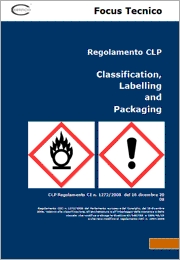
Regolamento CLP Classificazione, Etichettatura e Imballaggio Sostanze
Focus tecnico
Rev. 2.0 2013
Regolamento CLP
Classification, Labelling and Packaging
Il Regolamento CE n. 1272/2008 del 16 dicembre 2008, denominato Regolamento CLP (Classification, Labelling and Packaging), che è entrato in vigore nell'Unione Europea il 20 gennaio 2009, ha introdotto un nuovo sistema di classificazione, etichettatura ed imballaggio delle sostanze e delle miscele ed abrogherà le Direttive 67/548/CEE (DSP: Direttiva sulle sostanze pericolose) e 1999/45/CE (DPP: Direttiva sui preparati pericolosi) a partire dal 1 [...]
Featured
Guida Valutazione della sicurezza chimica
Il regolamento REACH si fonda sul principio che spetta al settore industriale garantire che le sostanze che fabbrica, immette sul mercato o utilizza non abbiano effetti avversi sulla salute umana e sul l’ambiente. Nell’ambito del regolamento REACH, la valutazione della sicurezza chimica riveste un ruolo importante in quanto è lo strumento che consente di assicurare l’identificazione e il controllo di tutti i rischi.
Il presente documento di orientamento fornisce un quadro generale della valutazione della [...]
Featured
Piano nazionale delle attività di controllo sui prodotti chimici
Anno 2016
PIANO NAZIONALE DELLE ATTIVITÀ DI CONTROLLO SULL’APPLICAZIONE DEI REGOLAMENTI (CE) N. 1907/2006 (REACH) E (CE) N. 1272/2008 (CLP) ANNO 2016 Il presente Piano è stato predisposto con la collaborazione del Gruppo Tecnico Interregionale REACH – CLP, con il Centro Nazionale Sostanze Chimiche dell’Istituto Superiore di Sanità e la Rete dei laboratori di controllo in attuazione all’Accordo CSR N. 88/2015.
Entro il 30 giugno 2017 il Ministero della Salute, con la [...]
Practical Guide on Safe Use Information for Mixtures under REACH
The Lead Component Identification (LCID) Methodology
The safe use of chemicals is one of the main objectives of REACH.
Chemical safety assessments (CSA) of substances are the main source of this information.
In a CSA the entire life cycle of a substance must be evaluated. In many cases substances are used in mixtures during their life cycle.
Therefore these uses have to be included in the CSA. But uses of [...]
Featured
C&L Inventory
This database contains classification and labelling information on notified and registered substances received from manufacturers and importers. It also includes the list of harmonised classifications (Tables 3.1 and 3.2 of Annex VI to the CLP Regulation) and the names of harmonised substances translated in all EU languages.
Companies have provided this information in their C&L notifications or registration dossiers. ECHA maintains the C&L Inventory, but does not review or verify the accuracy of the information.
The number of [...]
Featured
Methodology for recommending analytical methods to check compliance with REACH Annex XVII restrictions
This document presents a methodology to recommend analytical methods for checking the compliance with REACH Annex XVII restrictions.
The basic steps of the methodology are:
1. To define what are the functional qualities (characteristics) of an analytical method that can be attributed to the method in order to know how it works. General principles applied in widely accepted international standards as well as in other legislation fields [...]
Featured
Compendium on analytical methods to enforce restrictions
Compendium of analytical methods Recommended by the Forum to check compliance with REACH Annex XVII restrictions
The compendium describes over 100 recommended analytical methods that inspectors in Europe can use when checking compliance with REACH restrictions in Annex XVII. The compendium is also useful for companies facing inspections.
The ECHA Forum aims at contributing to harmonised enforcement of Regulation (EC) No 1907/2006 – REACH, throughout the EU.
Working in this framework the ECHA [...]
Articoli correlati Chemicals
Diesel and Gasoline Engine Exhausts: IARC classification

Diesel and Gasoline Engine Exhausts and Some Nitroarenes
This 105 Volume of the IARC Monographs contains evaluations of the carcinogenic hazard to humans of exposure to diesel and gasoline engine exhau...
Risk analysis: Le tecniche qualitative FMECA, HAZOP, FTA

Risk analysis: Le tecniche qualitative FMECA, HAZOP, FTA
ID 6447 | 02.07.2018 / Documento completo allegato
Analisi di base delle tecniche qualitative di analisi dei rischi (Hazard Evaluation Procedure...
Certifico s.r.l.
Sede: Via A. De Curtis, 28 - 06135 Perugia - IT
Sede: Via Madonna Alta 138/A - 06128 Perugia - IT
P. IVA: IT02442650541
Tel. 1: +39 075 599 73 63
Tel. 2: +39 075 599 73 43
Assistenza: 800 14 47 46
www.certifico.com
info@certifico.com
Sede: Via Madonna Alta 138/A - 06128 Perugia - IT
P. IVA: IT02442650541
Tel. 1: +39 075 599 73 63
Tel. 2: +39 075 599 73 43
Assistenza: 800 14 47 46
www.certifico.com
info@certifico.com
Testata editoriale iscritta al n. 22/2024 del registro periodici della cancelleria del Tribunale di Perugia in data 19.11.2024