


Circolare MLPS n. 8/2005
Circolare MLPS n. 8/2005
Leggi tuttoDisciplina di alcuni aspetti dell’organizzazione dell'orario di lavoro (D.Lgs. n. 66/2003; D.Lgs. n. 213/2004)
Con il decreto legislativo n. 66 dell’8 aprile 2003, integrato e m...













ID 22840 | 31.10.2024 / Attached
Railway accidents can cause death, injury and damage to property and the environment. The consequences can be even more serious if dangerous goods such as explosives, fuels, gases or other chemicals are being carried. If dangerous goods leak or if there is an explosion, fire or a gas cloud, this can have catastrophic consequences for people, property and the environment.
The Regulation concerning the International Carriage of Dangerous Goods by Rail (RID) is a tried and tested set of regulations that helps to prevent accidents or minimise the consequences of accidents.
The provisions of RID are the result of more than 130 years of proven practice in the carriage of dangerous goods by rail.
The main purpose of RID is to ensure safety during the carriage of dangerous goods and to minimise the risk and consequences of accidents during transport. It is substantially revised every two years to take account of scientific and technological developments and to learn lessons from accidents.
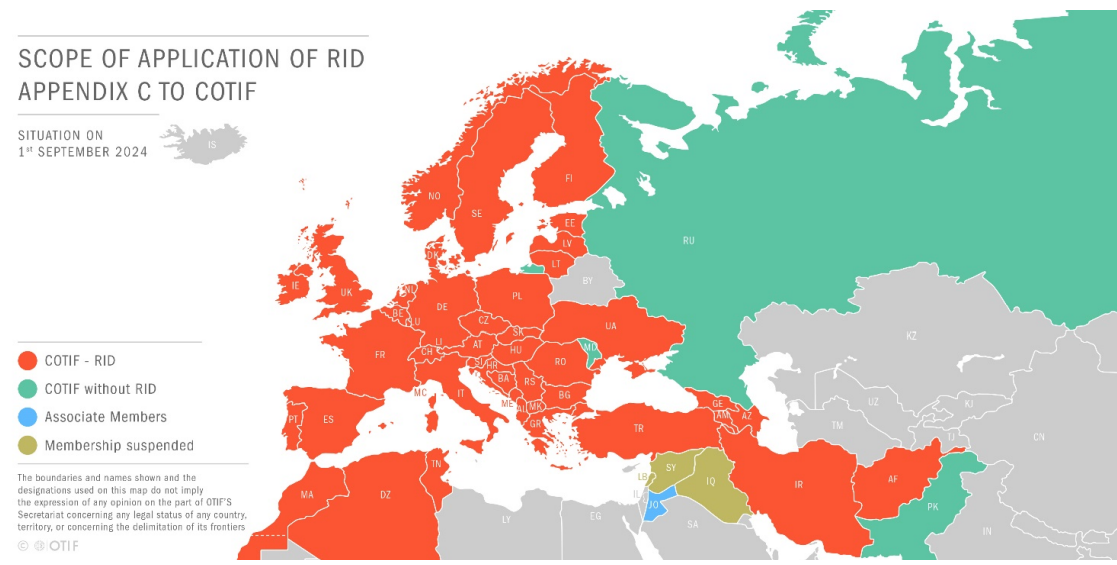
Contracting States and geographical scope The Regulation concerning the International Carriage of Dangerous Goods by Rail (RID) forms Appendix C to the Convention concerning International Carriage by Rail. RID currently has 45 Contracting States:
Afghanistan, Albania, Algeria, Armenia, Austria, Azerbaijan, Belgium, Bosnia and Herzegovina, Bulgaria, Croatia, Czech Republic, Denmark, Estonia, Finland, France, Georgia, Germany, Greece, Hungary, Iran, Ireland, Italy, Latvia, Liechtenstein, Lithuania, Luxembourg, Monaco, Montenegro, Morocco, Netherlands, North Macedonia, Norway, Poland, Portugal, Romania, Serbia, Slovakia, Slovenia, Spain, Sweden, Switzerland, Tunisia, Türkiye, Ukraine, United Kingdom.
Until international traffic is resumed, the OTIF membership of Iraq, Lebanon and Syria is suspended.
...
add attached
Disciplina di alcuni aspetti dell’organizzazione dell'orario di lavoro (D.Lgs. n. 66/2003; D.Lgs. n. 213/2004)
Con il decreto legislativo n. 66 dell’8 aprile 2003, integrato e m...
Direttiva 2009/71/Euratom del Consiglio, del 25 giugno 2009 , che istituisce un quadro comunitario per la sicurezza nucleare degli impianti nucleari
GU L 172 del 2.7.2009
Colleg...
1. Con sentenza del Tribunale di Torino -Sezio...
Testata editoriale iscritta al n. 22/2024 del registro periodici della cancelleria del Tribunale di Perugia in data 19.11.2024