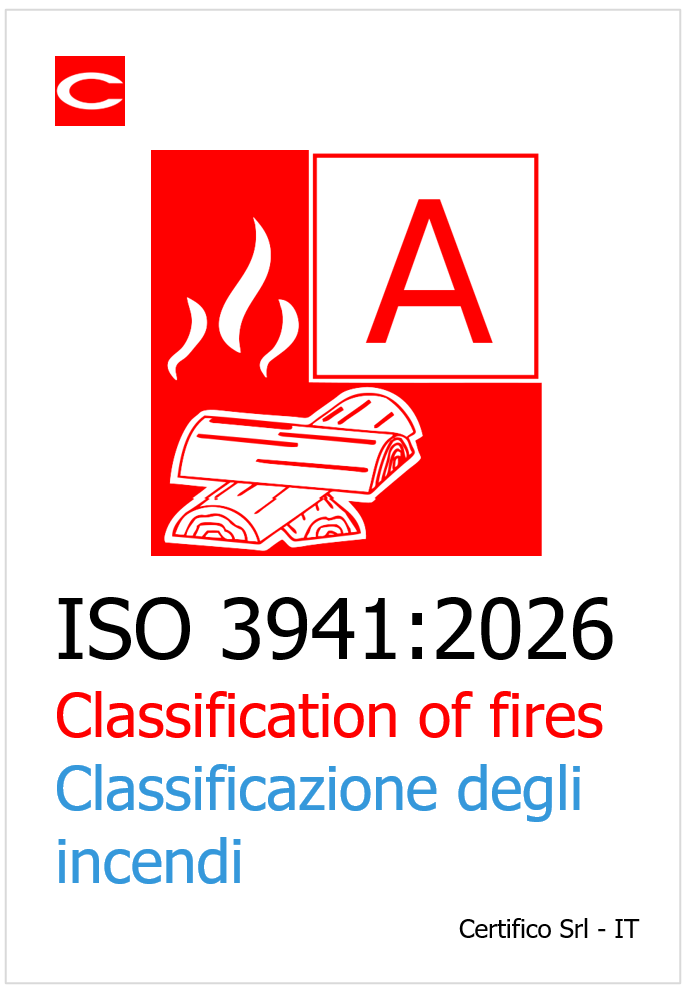
ISO 3941:2026 - Classification of fires / Classificazione degli incendi (fuochi)
ID 25391 | 23.01.2026 / In allegato
Nella Ed. 3.0 Gennaio 2026 della Norma ISO 3941 Classificazione degli Incendi, vengono introdotti gli Incendi (fuochi) di Classe L che coinvolgono celle e batterie agli ioni di litio, in cui non è presente litio metallico.
Gli incendi (fuochi) di Classe L sono incendi elettrochimici che, rispetto alla maggior parte degli incendi di Classe A, B, C, D e F, hanno una maggiore densità energetica che può comportare una velocità di crescita più rapida al momento del rilascio.
La Classe E (incendi di natura elettrica) non è prevista da diversi decenni (eliminata in Europa dalla UNI EN 2:2005) e mai dalla ISO 3941, dove le classi d'incendio (fuochi) sono definite in base al combustibile (uso residuale in taluni stati - vedi Australia).
Edizioni ISO 3941
Ed. 1 - 1977
Ed. 2 - 2007
Ed. 3 - 2026
_________
ISO 3941 was prepared by Technical Committee ISO/TC 21, Equipment for fire protection and fire fighting, Subcommittee SC 2, Manually transportable fire extinguishers.
This third edition cancels and replaces the second edition (ISO 3941:2007), which has been technically revised.
The main changes are as follows:
- addition of a classification for lithium-ion battery fires;
- addition of Clause 4 which provides information on the hazards related to the fire classes.
Any feedback or questions on this document should be directed to the user’s national standards body. A complete listing of these bodies can be found at www.iso.org/members.html.
Introduction
This document defines classes of fires according to the nature of the material undergoing combustion. In consequence, it does not define a particular class of fire involving an electrical risk.
1. Scope
This document classifies, into categories, the different kinds of fires each defined by the nature of the fuel. Such a classification is particularly useful in the context of equipment for fire protection and firefighting.
2. Normative references
There are no normative references in this document.
3. Terms and definitions
No terms and definitions are listed in this document.
ISO and IEC maintain terminology databases for use in standardization at the following addresses:
ISO Online browsing platform: available at https://www.iso.org/obp
IEC Electropedia: available at https://www.electropedia.org/
4. Definitions and designation of classes of fire
The following designations are for the purpose of classifying fires of different natures and of simplifying spoken and written reference to them:
Class A
Fires involving solid materials such as, but not limited to, wood, cloth, paper, rubber, and many plastics, usually of an organic nature, in which combustion normally takes place with the formation of glowing embers;
Class B
Fires involving liquids or liquefiable solids;
Class C
Fires involving gases;
Class D
Fires involving metals;
Class F
Fires involving cooking media (vegetable or animal oils and fats) in cooking appliances;
Class L
Fires involving lithium-ion cells and batteries, where no lithium metal is present. (New Ed. 3.0 2026)
Note: Class L fires are electrochemical fires that, by comparison to most class A, B, C, D, and F fires, have a greater energy density that can result in a faster growth rate when released.
5. Additional information related to the fire classes
5.1 For all classes
In addition to the hazards described below, the toxicity of the combustion products shall be considered for all classes of fire.
5.2 Related to class A
Class A fires can be either surface, where the fire is on the surface of the material or deep seated, where the fire is within the material.
5.3 Related to class B
For Class B fires, fuel containment and characteristics (e.g., polar or non-polar) shall be considered, as these- can impact the method of firefighting.
...
add attached
Collegati
Allegati
|
Descrizione |
Lingua |
Dimensioni |
Downloads |
 |
Abbonati Prevenzione Incendi
|
IT |
158 kB |
296 |