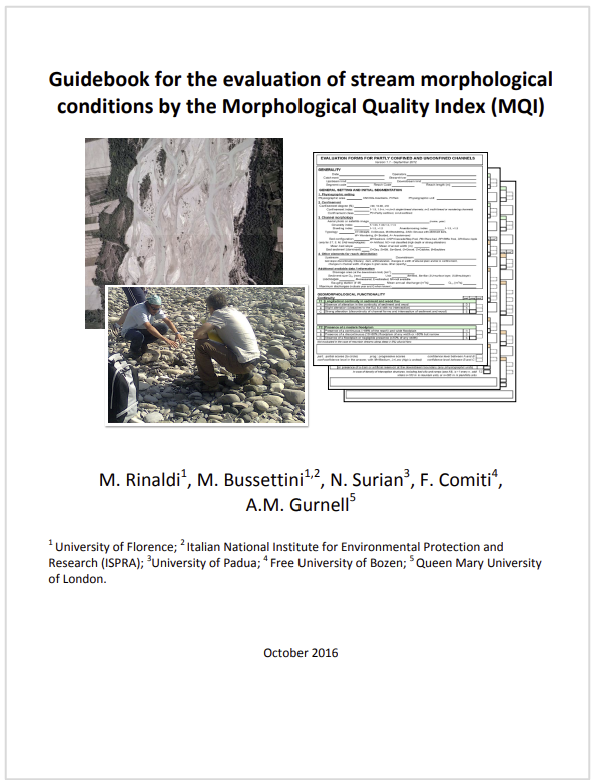
Guidebook for the evaluation of stream morphological conditions by the Morphological Quality Index (MQI) - ISPRA 2016
ID 28541 | 25.03.2026
This guidebook provides a detailed description of the Morphological Quality Index (MQI) and some integrated tools (MQIm, HMQI).
The Morphological Quality Index (MQI) was originally developed in Italy (Rinaldi et al., 2013), and then expanded and applied to other European countries within the context of the REFORM project (Rinaldi et al., 2015).
The guidebook is an extension of the REFORM report (Rinaldi et al., 2015) with more emphasis on low-energy streams and the inclusion of an Extended River Typology (ERT, Rinaldi et al., 2016), which is helpful at various phases of characterization and assessment.
Furthermore, an original tool, the Hydro-Morphological Quality Index (HMQI), has been developed and is described in detail.
This tool includes an additional indicator, concerning the alteration of flows without potentially relevant effects on channel morphology, which provides the opportunity to make an assessment of the overall hydromorphological condition of a river reach.
The Evaluation Forms for confined and for partly confined/unconfined streams respectively, a detailed Guide to the Compilation of the Evaluation Forms, which is used to support the application of the two indices, and an Illustrated Guide are provided in the Appendixes of this guidebook.
1 University of Florence;
2 Italian National Institute for Environmental Protection and Research (ISPRA);
3 University of Padua;
4 Free University of Bozen;
5 Queen Mary University of London.
October 2016
This guidebook provides a detailed description of the Morphological Quality Index (MQI) and some integrated tools (MQIm, HMQI).
The Morphological Quality Index (MQI) was originally developed in Italy (Rinaldi et al., 2013), and then expanded and applied to other European countries within the context of the REFORM project (Rinaldi et al., 2015).
The guidebook is an extension of the REFORM report (Rinaldi et al., 2015) with more emphasis on low-energy streams and the inclusion of an Extended River Typology (ERT, Rinaldi et al., 2016), which is helpful at various phases of characterization and assessment.
Furthermore, an original tool, the Hydro-Morphological Quality Index (HMQI), has been developed and is described in detail.
This tool includes an additional indicator, concerning the alteration of flows without potentially relevant effects on channel morphology, which provides the opportunity to make an assessment of the overall hydromorphological condition of a river reach. The Evaluation Forms for confined and for partly confined/unconfined streams respectively, a detailed Guide to the Compilation of the Evaluation Forms, which is used to support the application of the two indices, and an Illustrated Guide are provided in the Appendixes of this guidebook.
1 University of Florence;
2 Italian National Institute for Environmental Protection and Research (ISPRA);
3 University of Padua;
4 Free University of Bozen;
5 Queen Mary University of London.
October 2016
Indice di Qualità Morfologica (IQM)
L'Indice di Qualità Morfologica (IQM) è un metodo parametrico, introdotto in Italia dal DM 260/2010 e integrato nel sistema IDRAIM, per valutare lo stato geomorfologico dei corsi d'acqua.
Collegati
Allegati
|
Descrizione |
Lingua |
Dimensioni |
Downloads |
 |
|
EN |
31758 kB |
246 |