

~ 2000 / 2026 ~
// Documenti disponibili n:
49.469
// Documenti scaricati n:
42.603.574
// Newsletter n:
4578









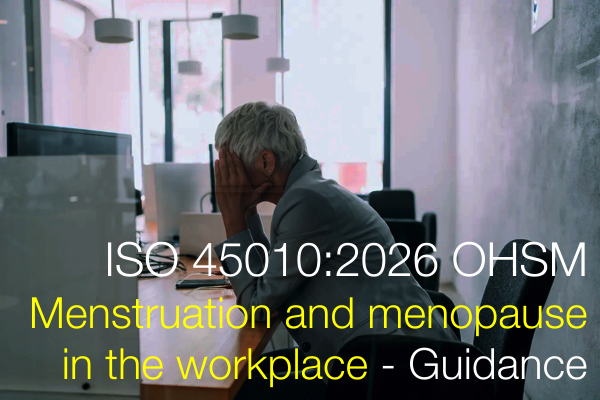
ISO 45010:2026 / OHSM Menstruation and menopause in the workplace - Guidance (Edition 1, Sept. 2026)
ID 4388
Per poter visualizzare la newsletter con i dati personalizzati devi essere connesso. Fai click qui per effettuare l'accesso al sito.
| Appunti Normazione | ||
| Newsletter n. 4321 del 14 Settembre 2026 | ||
 |
||
| Salve Visitatore | ||
ISO 45010:2026 / OHSM Menstruation and menopause in the workplace - Guidance (Edition 1, Sept. 2026) ID 27095 | 14 Settembre / Preview attached ISO 45010:2026 This document gives guidance to organizations on developing policies and practices that are supportive of workers’ menstrual and menopausal health and experiences in the workplace. 0.1 General The practical workplace adjustments and activities recommended in this document promote inclusive workplaces and complement good practice in workplace well-being, occupational health and safety (see ISO 45001) and gender inclusion in the workplace (see ISO 53800). Menstruation and menopause are not medical conditions but life course experiences (see Clauses A.1 and A.2). For many workers, the experience of menstruation and menopause is managed independently and privately without the need for additional support by organizations. However, organizations can introduce workplace adjustments, supportive mechanisms and policies that reduce stigma and make a significant and positive difference to workers. Providing a supportive and inclusive workplace environment around menstruation and menopause can have significant positive effects for worker engagement and job satisfaction, and a more inclusive and culturally safe workplace environment for all. A lack of knowledge, understanding or support for menstruation or menopause and their associated symptoms can lead to challenges including presenteeism, absenteeism, disengagement and additional or increased turnover costs. This document can assist employers and organizations, senior leaders, supervisors, human resource professionals (HR), occupational health and safety (OH&S) professionals, onsite healthcare professionals, well-being and diversity and inclusion (D&I) practitioners, and architects and interior designers responsible for workspace construction and refurbishment. It can also support workers who are responsible for managing individuals’ performances, workloads, well-being or work environments. NOTE 1 Further information on menstrual and menopausal health can be found in Annex A. 0.2 Why start addressing this topic now? By 2030, over 1,2 billion women worldwide will be menopausal or postmenopausal, and 1,8 billion women menstruate every month, meaning a significant number of workers are or will experience menstruation and menopause while in the workplace. While gender parity in labour force participation varies across different economies, it is often the case that women are expected to fit into modes of working and cultural expectations that were historically designed at a time when women were not equally represented or prioritized as workers. Symptoms associated with menstruation and menopause can also coincide with significant life challenges and responsibilities, and research has shown that stress and symptoms associated with menopause are closely linked. For example, symptoms associated with menstruation and menopause can occur when workers are also dealing with stressors such as other health conditions, fertility issues, pregnancy loss, deaths of significant others, managing childcare and care for older parents, children leaving home, financial constraints, relationship breakdown or other significant life events. Promoting and supporting the health of workers brings multiple benefits to organizations, such as reducing occupational risks and absences. By fostering inclusivity, supporting worker well-being, and eliminating discrimination, organizations can also enhance their reputation and attract a diverse workforce. Workers can experience menstrual or menopausal symptoms which can impact their experience of work and can cause them to leave an unsupportive work environment. Symptoms experienced in an unsupportive environment can also contribute to underemployment or working fewer hours, which can impact their career trajectories, promotional prospects and financial security in later life. Implementing good practice around supporting menstruation and menopause in the workforce also benefits organizations by: Collegati 
|
||
 |
||
|
sono siti di: Se vuoi cancellarti dall'invio della newsletter clicca qui oppure effettua il login al sito ed entra nella Tua Area Riservata, in “Modifica dati” agisci con la spunta sul box di selezione “newsletter”. L'elenco completo di tutte le ns newsletter è qui: Archivio newsletter certifico.com
Testata editoriale iscritta al n. 22/2024 registro periodici Tribunale di Perugia 19.11.2024 |
||
   |
||
 |
||
| Certifico Srl 2000-2026 | VAT IT02442650541 | ||

Certifico s.r.l.
Sede: Via A. De Curtis, 28 - 06135 Perugia - IT
Sede: Via Madonna Alta 138/A - 06128 Perugia - IT
P. IVA: IT02442650541
Tel. 1: +39 075 599 73 63
Tel. 2: +39 075 599 73 43
Assistenza: 800 14 47 46
www.certifico.com
info@certifico.com
Sede: Via Madonna Alta 138/A - 06128 Perugia - IT
P. IVA: IT02442650541
Tel. 1: +39 075 599 73 63
Tel. 2: +39 075 599 73 43
Assistenza: 800 14 47 46
www.certifico.com
info@certifico.com
Testata editoriale iscritta al n. 22/2024 del registro periodici della cancelleria del Tribunale di Perugia in data 19.11.2024