

~ 2000 / 2026 ~
// Documenti disponibili n:
49.724
// Documenti scaricati n:
43.178.097
// Newsletter n:
4832

















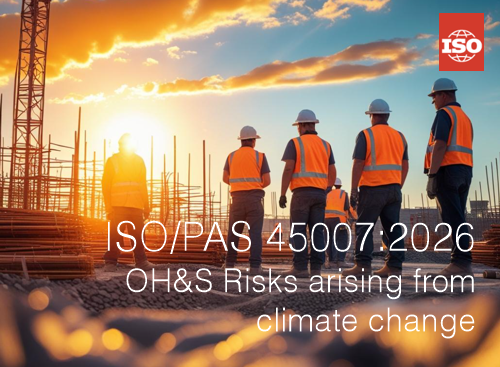
ISO/PAS 45007:2026 | OH&SRisks arising from climate change and climate change action
ID 1641
Per poter visualizzare la newsletter con i dati personalizzati devi essere connesso. Fai click qui per effettuare l'accesso al sito.
| Appunti Normazione | ||
| Newsletter n. 1576 del 23 Ottobre 2026 | ||
 |
||
| Salve Visitatore | ||
ISO/PAS 45007:2026 | OH&S ID 25360 | 19.10.2026 / Preview attached ISO/PAS 45007:2026 Published (Edition 1, 2026) This document gives guidance to organizations on planning for and addressing occupational health and safety (OH&S) risks arising from climate change and climate change action, including: - OH&S risks which arise as a result of climate change adaptation efforts, including changing ways of working and work processes, and infrastructure upgrades; This document is applicable to all organizations taking a systematic approach to addressing OH&S risks arising from climate change. It is applicable to organizations of all sizes including small and medium-sized enterprises (SMEs). [...] ISO/PAS 45007:2026 Introduction Climate change poses significant challenges to organizations worldwide, impacting not only the environment but also occupational health and safety (OH&S), meaning that it is important that organizations proactively address the OH&S challenges arising from climate change and climate change actions. This document provides comprehensive guidance for organizations to manage these risks and opportunities effectively. This document is intended for all organizations, whether or not they have implemented informal or formal OH&S management system such as ISO 45001. Such a management system includes the relevant elements of a Plan-Do-Check-Act (PDCA) system. Taking a systems approach facilitates the coordination of resources and efforts, which is important in managing climate change. This document will assist organizations to better understand the impacts of climate change and climate change actions on OH&S and to create resilient and sustainable work environments that protect the health and safety of workers. It encompasses OH&S risks resulting from climate change itself, as well as those arising from climate change adaptation efforts, such as changes in work processes or infrastructure upgrades, and those associated with climate change mitigation efforts aimed at reducing greenhouse gas (GHG) effects or an organization’s carbon footprint. It also highlights the opportunities to enhance workplace health and safety through proactive measures. Due to the nature of the subject, many definitions and concepts have been imported from the fields of climate change science and adapted to the context of hazard identification and assessment and control of OH&S risks, with focus on both health and safety impacts and opportunities. 1 Scope This document gives guidance to organizations on planning for and addressing occupational health and safety (OH&S) risks arising from climate change and climate change action, including: - OH&S risks which arise as a result of climate change adaptation efforts, including changing ways of working and work processes, and infrastructure upgrades; This document is applicable to all organizations taking a systematic approach to addressing OH&S risks arising from climate change. It is applicable to organizations of all sizes including small and medium-sized enterprises (SMEs). 2 Normative references There are no normative references in this document. 3 Terms and definitions For the purposes of this document, the following terms and definitions apply. ISO and IEC maintain terminology databases for use in standardization at the following addresses: - ISO Online browsing platform: available at https://www.iso.org/obp 3.1 climate statistical description of weather in terms of the mean and variability of relevant quantities over a period of time ranging from months to thousands or millions of years Note 1 to entry: The usual period for considering these variables is 30 years, as defined by the World Meteorological Organization. Note 2 to entry: The relevant quantities are most often near-surface variables such as temperature, precipitation and wind. [SOURCE:ISO 14090:2019, 3.4] 3.2 climate change change in climate (3.1) that persists for an extended period, typically decades or longer Note 1 to entry: Change in climate can be identified (e.g. by using statistical tests) by changes in the mean and/or the variability of its properties. Note 2 to entry: Climate change can be due to natural processes, internal to the climate system, or external forces such as modulations of the solar cycles, volcanic eruptions, and persistent anthropogenic changes in the composition of the atmosphere or in land use. [SOURCE: ISO Guide 84:2020, 3.1.2] 3.3 climate change action initiative to achieve climate change measures or goals based on mitigation and/or adaptation priorities under climate change policies Note 1 to entry: Climate change action intends to a) reduce or prevent emissions or enhance removals, and b) reduce vulnerability, maintain and increase the resilience, and increase adaptive capacity of human and ecological systems from adverse climate change impacts (3.5). [SOURCE: ISO 14080:2018, 3.1.1.1, modified - “change” added to the term.] 3.4 climate change adaptation process of adjustment to actual or expected climate (3.1) and its effects Note 1 to entry: In human systems, adaptation seeks to moderate or avoid harm or exploit beneficial opportunities. Note 2 to entry: In some natural systems, human intervention can facilitate adjustment to expected climate and its effects. [SOURCE: ISO 14090:2019, 3.1, modified - “climate change adaptation” replaced “adaptation to climate change” as the preferred term.] 3.5 climate change impact effect on natural and human systems of extreme weather and climate events and of climate change (3.2) Note 1 to entry: Impacts generally refer to effects on lives, livelihoods, health, ecosystems, economies, societies, cultures, services and infrastructure due to the interaction of climate change or hazardous climate events occurring within a specific time period and the vulnerability of an exposed society or system. Impacts are also referred to as consequences and outcomes. The impacts of climate change on geophysical systems, including floods, droughts and sea level rise, are a subset of impacts called “physical impacts”. [SOURCE:ISO 14090:2019, 3.8, modified - “climate change” added to the term. “of extreme weather and climate events and of climate change” added to the definition. “In the context of climate change” deleted from Note 1 to entry.] 3.6 climate change mitigation human intervention to reduce greenhouse gas (GHG) emissions or enhance GHG removals [SOURCE: ISO 14080:2018, 3.1.2.1, modified - “to reduce greenhouse gas (GHG) emissions or enhance GHG removals” replaced “to reduce the sources or enhance the sinks of greenhouse gases (GHGs)” in the definition.] 3.7 climate change risk risk of negative climate change impacts (3.5) that reflects the interaction among vulnerability, exposure and hazard Note 1 to entry: A risk assessment can include the consideration of vulnerabilities, exposure and climate change hazards, or the consideration of likelihoods and consequences. [SOURCE: ISO Guide 84:2020, 3.1.6] 3.8 extreme weather event event that is significantly different from typical weather patterns or occurrences Note 1 to entry: What is considered extreme can change based on location and can change over time. 3.9 impact chain analytical approach that enables understanding of how given hazards generate direct and indirect impacts which propagate through a system at risk 3.10 organization person or group of people that has its own functions with responsibilities, authorities and relationships to achieve its objectives Note 1 to entry: The concept of organization includes, but is not limited to, sole-trader, company, corporation, firm, enterprise, authority, partnership, charity or institution, or part or combination thereof, whether incorporated or not, public or private. 3.11 occupational health and safety risk OH&S risk combination of the likelihood of occurrence of a work-related hazardous event(s) or exposure(s) and the severity of injury and ill health that can be caused by the event(s) or exposure(s) Note 1 to entry: In this document, referring to “OH&S risk” means OH&S risks and risks to the OH&S management system. Note 2 to entry: OH&S risk includes the “cause - effect” relationship of cascading risks (chain of events) in the context of climate change (3.2), for both existing and new/emerging risks. [SOURCE: ISO 45001:2018, 3.21, modified - Notes 1 and 2 to entry added.] Fonte: ISO Collegati 
|
||
 |
||
|
sono siti di: Se vuoi cancellarti dall'invio della newsletter clicca qui oppure effettua il login al sito ed entra nella Tua Area Riservata, in “Modifica dati” agisci con la spunta sul box di selezione “newsletter”. L'elenco completo di tutte le ns newsletter è qui: Archivio newsletter certifico.com
Testata editoriale iscritta al n. 22/2024 registro periodici Tribunale di Perugia 19.11.2024 |
||
   |
||
 |
||
| Certifico Srl 2000-2026 | VAT IT02442650541 | ||

Certifico s.r.l.
Sede: Via A. De Curtis, 28 - 06135 Perugia - IT
Sede: Via Madonna Alta 138/A - 06128 Perugia - IT
P. IVA: IT02442650541
Tel. 1: +39 075 599 73 63
Tel. 2: +39 075 599 73 43
Assistenza: 800 14 47 46
www.certifico.com
info@certifico.com
Sede: Via Madonna Alta 138/A - 06128 Perugia - IT
P. IVA: IT02442650541
Tel. 1: +39 075 599 73 63
Tel. 2: +39 075 599 73 43
Assistenza: 800 14 47 46
www.certifico.com
info@certifico.com
Testata editoriale iscritta al n. 22/2024 del registro periodici della cancelleria del Tribunale di Perugia in data 19.11.2024